


Most people who type "sciatica" into a search bar at two in the morning do not have sciatica. They have back pain, which is miserable enough, but a different problem with a different outlook. The word matters because the two are assessed and treated differently, and because a short list of sciatica symptoms needs a hospital the same day. This guide sets out how to tell the two apart, what to do in the first weeks, which symptoms mean A&E now, and what the NICE guidance for low back pain and sciatica, updated in July 2026, says actually helps.
What sciatica is, and what it is not
The sciatic nerve runs from the lower back, through the buttock and down the back of each leg to the foot. Sciatica is what happens when that nerve is irritated or compressed, most often by a bulging disc in the lower back pressing on a nerve root. The NHS lists the symptoms as a sharp, burning pain down the back of the leg, tingling like pins and needles, numbness and weakness, usually in the buttock and the back of one leg and often reaching the foot and toes. The pain can start suddenly or build up, and it tends to be worse when you move, cough or sneeze.
Ordinary low back pain is different. It sits across the lower back and may spread into the buttock or the top of the thigh, it is more of an ache or a stiffness than a line of pain, and it does not bring pins and needles or weakness in the leg. The NHS puts it simply: if you only have back pain, it is unlikely to be sciatica. Both are common, both usually settle, and both are among the conditions osteopaths help with, but the leg symptoms change what we look for.
Three questions that usually tell them apart
Where is the worst of it? With sciatica the leg usually hurts more than the back, and the pain travels below the knee. With back pain the back is the problem and anything in the leg stays above the knee.
Is there a change in feeling or strength? Pins and needles, a numb patch on the foot or shin, or a foot that drags or feels weak point to the nerve. A stiff back that hurts to bend does not do that.
Is it one side? Sciatica almost always affects one leg. Symptoms in both legs at once are not typical sciatica and are one of the signs to act on today, which brings us to the list below.
The symptoms that need A&E today
A rare but serious problem called cauda equina syndrome, where the nerves at the base of the spine are compressed, needs same-day hospital treatment to avoid permanent damage. The NHS says to go to A&E or call 999 if you have sciatica and any of these:
- sciatica on both sides
- severe or worsening weakness or numbness in both legs
- numbness around your genitals or bottom
- difficulty starting to pee, being unable to pee, or being unable to control when you pee, when that is not normal for you
- not noticing when you need to poo, or being unable to control your bowels, when that is not normal for you
Do not drive yourself; ask someone to take you or call an ambulance, and take your medicines with you. None of these is something to sleep on or to book an osteopathy appointment for.
What to do in the first few weeks
For sciatica and for back pain alike the advice is the same, and it is the opposite of what the pain tells you to do. The NHS says to carry on with your normal activities as much as you can, start gentle movement and the NHS sciatica exercises as soon as possible, use a heat pack on the painful area, and avoid sitting or lying down for long periods, even if moving hurts. Movement is not harmful and it speeds recovery. Bed rest makes both problems last longer.
On painkillers, ask a pharmacist. The NHS notes that paracetamol on its own is unlikely to help sciatica and that the benefit of anti-inflammatories such as ibuprofen is unclear. NICE goes further for sciatica: it says not to offer gabapentinoids, other anti-epileptic medicines, oral steroids or benzodiazepines for it, and not to offer opioids for sciatica that has become long-term, because the evidence does not support them.
See a GP if the pain has not improved after a few weeks of this, is getting worse, or stops you doing your normal activities. Sciatica usually gets better in a few weeks to a few months, though it can last longer and can come back.
What the NICE guidance says helps, and what it rules out
NICE guideline NG59 covers low back pain and sciatica together in people over 16. Its care is built on exercise and supported self-management: keep doing normal activities, and consider a group exercise programme suited to your needs and preferences. It says not to offer belts or corsets, foot orthotics, rocker-sole shoes, traction, acupuncture, ultrasound or TENS for low back pain, and not to order scans routinely, because the results rarely change what should be done.
On hands-on treatment the wording was tightened on 29 July 2026. NICE now says that manual therapy, meaning spinal manipulation, mobilisation or soft tissue techniques such as massage, should be considered only within a treatment package that includes exercise. Manual therapy on its own is not recommended. The recommendation for cognitive behavioural therapy as part of that package was withdrawn at the same time.
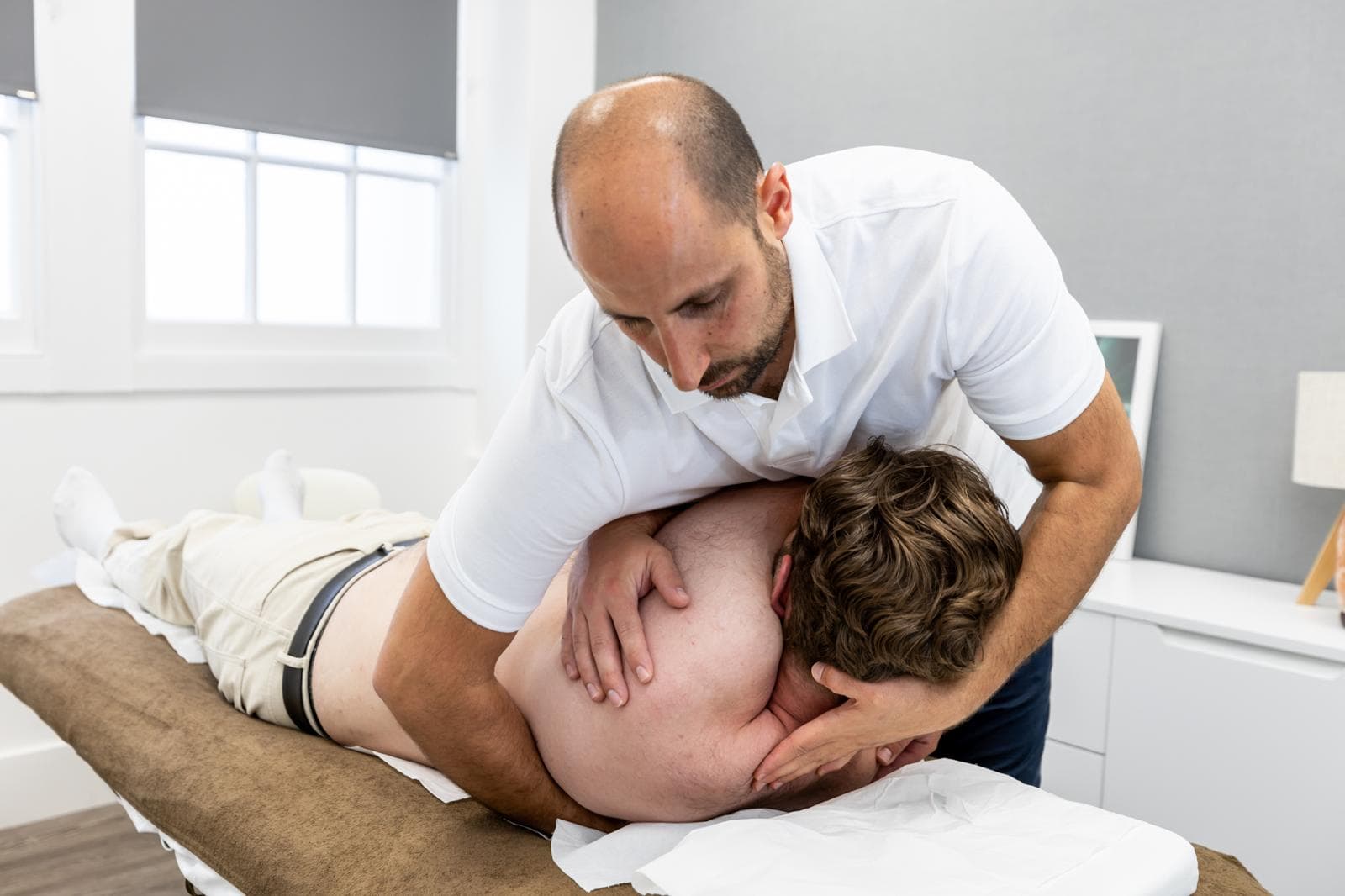
That is how osteopathy is practised here. Treatment for sciatica or back pain is hands-on work to take load off the irritated segment and free the muscles that have tightened around it, paired with exercises that build up as the pain settles and advice on the positions, lifting and sitting that ease it. Osteopathy could help with sciatica and with back pain; both are on the list of conditions the Advertising Standards Authority accepts osteopathy can help with, and the assessment comes first.
What an assessment at the clinic involves
The first appointment is longer than a follow-up, because most of it is assessment. It starts with your history: where the pain is, what started it, what makes it better and worse, and whether anything in the list above has happened. Then a physical and neurological examination, which for leg symptoms means checking reflexes, strength and sensation along the nerve to see how irritated it is. The point is to work out what is pressing on what, and whether it is something osteopathy can help with or something that needs your GP or a scan first. If it is the latter, you will be told so plainly.
A first visit, including the consultation, is £80, and continuing treatment is £70. No referral is needed. Read more on our sciatica and back pain pages, see how osteopathy treatment works at the clinic, and book an appointment online or by calling 01224 707877.
Sources
- NHS: sciatica
- NHS: back pain
- NICE guideline NG59: low back pain and sciatica in over 16s, assessment and management
- Committee of Advertising Practice: health, osteopathy (the accepted conditions list)
This article is general information, not personal medical advice. If you have any of the symptoms in the A&E list, go to A&E or call 999 now.

Related treatments
More from the blog
Osteopathy for Babies and Children in Aberdeen: A Parent's Guide
How osteopathy for babies and children works, the gentle techniques used, how it may help, what we will not claim, when to see your GP, and what a visit costs.

Vitamin D in Scotland: Why the NHS Says Take a Supplement from October to March
From October to March the sun in Scotland is too weak to make vitamin D. What the NHS advises, who needs a supplement all year, and how much is too much.
How to Choose an Osteopath in Aberdeen: the Register, Insurance and Five Questions to Ask
How to check the GOsC register, what registration guarantees, how health insurance works, and five questions to ask before you book an osteopath in Aberdeen.
Book your appointment
Need an appointment or just have a general enquiry? Complete the form and we'll be in touch within 24 hours. If you require to be seen urgently or need some initial advice, please give us a call.